Wednesday, March 21, 2012

Morocco


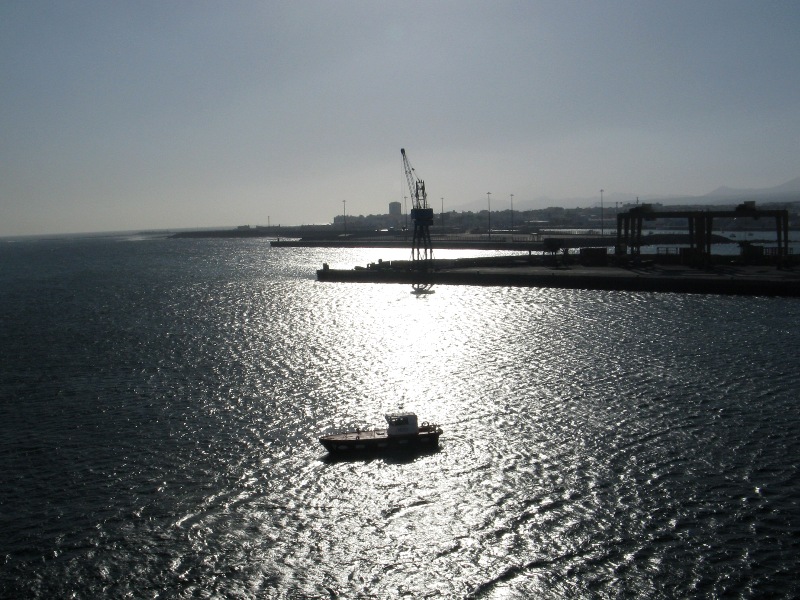
The Silver Wind's first stop in Morocco was at the small city of Agadir in the south of the country.  The city is an agricultural transshipment point, the location of a thriving fishing industry and a tourist resort due to its long sandy beach.  The stop at Agadir was primarily to let off passengers who had booked the ship's overnight tour to Marrakech.  As the ship landed, Michael and I saw about a dozen folks waiting in the lobby with their overnight bags.  It's amazing the amount of "stuff" rich people think they need for one overnight.  I say rich people because the trip cost more than $2000 per person for a bus ride, a fancy meal, a tour and a hotel room for one night.

As usual, Michael and I took the first free shuttle bus to the downtown area.  A major earthquake leveled the city in 1960.  Agadir has been rebuilt as an airy, open modern city. The guide on the shuttle bus explained the local economy as the bus detoured through the fishing docks where we saw the day's catch of sardines bought and sold on the jetty pavement. He said that Agadir is the world's largest exporter of sardines.  The port is a few miles from the city center and its boulevards, beaches and resort hotels.  We got off the bus at a large square next to the Valley of the Birds, a city park and bird sanctuary that was not yet open at 9:00 a.m.  In fact, nothing was open at 9:00 a.m. beyond the occasional coffee shop and the local McDonald's.  I got a kick out of posing next to a stop sign in Arabic.

 It is most pleasant to be out and about before the crowds. It is fascinating to watch shopkeepers and trinket sellers set up their stalls and get ready for the day's business.  We walked through a market that was just getting organized and were able to watch some leather workers cutting and stitching wallets and purses.

The market, the small local mosque, the bird sanctuary and the beach resorts seemed to complete the list of local sights.  After a walk through the sleepy streets, we caught the next shuttle bus back to the ship. 

Michael and I had a pleasant walk around the city and were ready for our 1:00 p.m. departure for Casablanca.


The next morning we docked in Casablanca.  The famous movie of the same name, except for a few exterior shots, was not really filmed here.  Our tour, "Casablanca and the Grand Mosque," drove us by "Rick's Cafe," a rundown bar (at least the exterior) that was named after the one in the movie.  Otherwise, Casablanca is a completely modern Arab city with French inspired wide boulevards between many roundabouts and crooked streets in older areas.  The architecture is French Colonial, modern, Spanish and Arabic. The area called the new medina looks like a walled slum and the old medina in another part of the city is mostly a tourist area.  The really big attraction is the Hassan II Mosque, the second largest mosque in the Arab world.  It has the largest minaret in the world at 210 feet, a retractable roof and an over the top interior.  My photos do not really do it justice.  Everything is overwhelmingly huge and ornate.

I'm writing this after having visited the Alhambra at Grenada, Spain at a later stop.  It is clear that this huge mosque is making a statement that modern Islam is more powerful in every way than anything that came before.  Unfortunately, the Hassan II Mosque is not as delicate or beautifully proportioned as the Alhambra.  It overwhelms the senses with sheer size and quantity of complex ornamentation.  The builders of the Alhambra mastered dramatic settings with natural light, careful placement of architectural elements and the clever use of water.  True, the Alhambra is a palace, not a mosque but the relationship between it and Hassan II is obvious.

We made a photo stop a mile away near a lighthouse to view the mosque from a distance.  We then took the usual drive along the shore, through the rich neighborhoods, past the racetrack and back to the city center.

Our tour of Casablanca showed that it is a city of traffic jams, severe enough that we missed a couple of advertised stops in order to make sure we had time for the inevitable retail experience at what I assume is the guide's cousin's store.

The bus battled more traffic as we drove through the street market. We stopped for a walking tour of the old medina and a view of the door to the sultan's palace.  We encountered more traffic jams on our way past Mohammed V Square (no photo opportunity here) and all the way back to the port.

Casablanca is a moderately interesting city with a BIG mosque. It is not the romantic city everyone imagines.  There was a lot of construction underway, contributing to the traffic.  I wonder who is financing the large amount of infrastructure we saw being upgraded and the new high rises that now block the view from the Atlantic of the immense mosque.  A Google search shows the Moroccan economy is based on Tourism, Potash, Agriculture and the illegal export of hashish.


Monday, March 19, 2012

Pictures from Lanzarote


I've included many pictures in this post. Lanzarote is such a unique volcanic island that it deserves a close up pictorial description.

When we landed, the first thing we saw driving from the port was a wrecked freighter sitting on the shore. We crossed half the island to get to our destination.

When we arrived at Timenfaya National Park we were handed warm rocks straight from the ground. We saw a demonstration of the heat just underneath us as straw was set on fire by putting it in a  shallow hole.  The final demonstration showed how cold water poured down a pipe set in the ground turned explosively to steam in just a few seconds.  Michael was worried about the safety of standing on a volcanic spot..  After all they were taking bus loads of tourists into active volcanic zones.  I was much relieved to see seismic monitors around the area during our spectacular bus ride through the various uneroded landforms.

Following the national park visit we stopped for dromedary rides at the edge of the official park territory. I took a fantastic photo of Michael and the head of the camel behind him.  They seem to have the same expression!

I have included  photos of the winery and its semi-circular fences protecting the gape vines.

We went into the town of Arrecife later in the afternoon.  The final shot is of a small boat watching our sunset departure.

My next posts will be about our visits to two ports in Morocco and Cadiz, Malaga, Ibiza, Majorca, and Barcelona in Spain.

Pictures from Tenerife


I'm home now.  I haven't kept up with this blog as Michael has been ill and I have been catching up on things that needed to be done in the house and taking lots of naps to combat jet lag.  Last night I cooked Michael a roast chicken.  Maybe its the antibiotic or maybe it was the chicken but today he seems to be getting better.  Anyway, it is time to conclude this story so I hope to be working on it more regularly.

Here are some pictures from Tenerefe where we took the light rail tram to La Laguna about 1200 feet above sea level.


Friday, March 9, 2012

Las Palmas to Barcelona, the Final Cruise Segment


The Canary Islands

I'm writing this on Friday, March 09, 2012, our last "at sea" day of the cruise.  Since arriving at Las Palmas, we haven't had a day without a shore visit and I have had little time to write.  In any case, the pictures tell most of the story.

The big news is that I finally sold my Tennessee house!  My real estate agent e-mailed me that after a number of delays; the closing DID take place on Tuesday.  I no longer need worry about phone calls from Tennessee neighbors that start, "I was looking at your house and I saw water coming out from under the garage door." That actually happened two years ago.  No more worrying about thousands of dollars worth of damages and repairs.  No more mortgage payments.  Hooray!

We visited three Canary Islands and made two stops in Morocco before this good news arrived.  Even though I was nervously awaiting the closing, I did manage to enjoy the stops immensely.

The surprise up-grade to a veranda cabin ended and we moved down to deck four and our old familiar cabin 437.  See Michael's blogs for the humorous details surrounding this event: http://cbu-africa1202.blogger.com

Our visits to Las Palmas, Tenerife and Lanzarote were a study in the differing effects of volcanic activity. 

Las Palmas was the least striking.  Michael and I did not take an organized tour of the volcanic island but explored the city on our own.  It was refreshing to see a European city after nearly a month in Africa.  Our initial walk around the harbor area only revealed an ordinary looking city, but we stumbled upon the central market, which was clean and had good-looking produce, meat and fish.  We found an interesting red painted church dedicated to Our Lady of the Pine Tree (no kidding) and I saw my first interior of a highly decorated Spanish church.  We avoided the shopping centers and malls.

After lunch on the Silver Wind, we ventured out again.  This time we took one of the red hop-on, hop-off sightseeing bus with the recorded narration that is found in almost every major city.  Michael had saved the receipt from Cape Town, so we got a 10% discount. We got off at the old historic district several miles from the port and explored the Cathedral square and the maze of 16th century streets around it.  It was siesta time and most shops were closed, including the cathedral. There were statues of dogs – I discovered that the islands are named after dogs (l. canis), not birds.  The birds are named after the islands.  After the bus tour, we visited a beautiful beach where Michael discovered a free wi-fi hot spot.  Hint: it's where all the young people with laptops and smart phones are hanging out typing madly.  We watched a beautiful sunset from the Silver Wind as we departed our first stop in the Canaries.

Tenerife offered a different experience.  Michael had visited some years ago and told me that the tour to the Mount Teide National Park to see the volcanic crater was similar to visiting Mt. Haleakalea in Hawaii, a dormant if not extinct volcano, which I had done. It was interesting but there were other sights to see.  A friend aboard told Michael about the electric tram from Santa Cruz, where we landed, to a town on the mountainside, La Laguna, that was the old colonial capital of the island.  This mountain town, originally settled around 1490, had a wonderfully preserved historic section.  For five Euro total (about $7.00 US) we bought round trip tickets on the tram and had a marvelous four or five hours exploring La Laguna for one tenth the cost of one tour ticket.  We watched another lovely sunset as the ship left Tenerife for Arrecife, Lanzerote, the Canary Islands.

Michael and I sprang for the all day tour of Lanzerote, the most volcanic of the three islands we visited.  A volcanic eruption in 1730 created the mountains that cover nearly half the island and a second eruption in the 1840's further altered the landscape with lava and pyroclastic flows.  There is no rain on Lanzarote though the humidity is high and there is dew every night.  There is some agriculture mainly grape vines surrounded by weird circular fences.  Otherwise the landscape is uneroded and bizarre.  We went to the Timenfaya National Park to see the Montana de Fuego (Fire Mountains) and ride a dromedary (camel). The tour also included a stop at a winery to taste the amazing local wines (not good, just amazing the grapes can be grown there).  We later went into the town of Arrecife, pretty and just being developed into a major tourist attraction.  Another stunning sunset departure and we were on our way to Morocco.


--
Barbara Borsuk
barbara@mborsuk.com
Boulder, Colorado, USA
303 408-3639

Sunday, March 4, 2012

THE MYSTERIOUS CAPE VERDE ISLANDS


Mysterious is probably not the best description of the Cape Verde Islands but the word gives a hint that things superficially viewed may not be really understood.  That serves as a summary of a day each spent on two of the ten islands.

The Silver Wind visited Praia, the capital of the Republic of Cape Verde on Monday February 27, 2012.  Praia is on the southern end of Santiago, the southernmost inhabited island in the chain.  It was settled by the Portuguese in the fifteenth century and gained its independence from Portugal in 1975.

We arrived at 8:00 a.m. and departed at 6 p.m.  Michael and I chose not to take a tour but took the earliest shuttle bus to the older part of Praia, a couple of miles from the port.  The old colonial city sits upon a bluff overlooking a small harbor.  The shuttle bus climbed steep cobblestones streets to deliver us to an esplanade overlooking our ship.  From there we took our own walking tour of the sights using a map provided by the Shore Concierge Desk on the Silver Wind.  We saw the fortified cliff top, the church, the city hall, Albuquerque Square and the market.  A street running from the square past the market was blocked off to vehicular traffic and made a pleasant pedestrian mall.  We strolled around the area enjoying the colorfully dressed people, neat buildings and generally European flavor of the old city.

A much larger city area spread below the plateau, extending several miles along the shore and up the small valley in which Praia was set. Many more buildings that are modern filled this area.  A great number appeared to be under construction. For many, the construction had apparently halted some time ago.  Others were busily currently under construction.

The population of mixed African and Portuguese descent, while obviously not rich, appeared much more prosperous than the people of the Gambia or Ghana.  We saw little industry and not much of agriculture.  The source of Cape Verdeans' relative prosperity was not obvious.  Our literature on Cape Verde indicated that the main source of income is "remittances" and foreign aid.  Later, when we talked with people from our ship that had gone on the organized tour, they told us their guide said that China was a major foreign investor.  Remittances refer to money sent back to Cape Verde from citizens and relatives living abroad.

Back on the Silver Wind, we spent part of the afternoon watching a truck full of boxes that looked like peaches being loaded almost entirely by hand on a small freighter.  In contrast, a medium sized freighter on the other side of us loaded standard metal containers.  A crane operator and several dockworkers skillfully guided the containers to their places and joined them together just as is done in any modern port.  Six local police guarded our ship or perhaps, guarded the containers piled next to the ship from us.  Bulldozers, cranes and dump trucks were busy extending the breakwater. It was a busy little port.

Michael and I immensely enjoyed the afternoon sail away as we relaxed on our veranda watching the shore slip by.  The unraveling of the mysteries of Cape Verde would wait for another day.


--
Barbara Borsuk
barbara@mborsuk.com
Boulder, Colorado, USA
303 408-3639

SANTO ANTAIO (Saint Anthony)


Michael and I signed up for an all day tour of Santo Antao, the northernmost inhabited Cape Verde island.  We reached Porto Novo, Sato Antao around 8:00 a.m. to find that there was no dock available.  No one had told the cruise line that the docks are not there but are a work in progress.  There was space for only the busy inter island ferry.  Consequently we tendered (took the lifeboats) to the dock. I thought the up and down across the waves was fun but I was in the minority.

Our second day exploring this unique island nation mainly involved a daylong bus tour of this picturesque volcanic island.  The landscape was unlike that I have seen anywhere else.  It is late in the dry season and most of the vegetation was brown and the soil was bare in many spots. The island is mountainous with dizzying heights and steep drops.  Our guide told us that until recently there was just one road across the island from Porto Novo in the south to the fishing village on the north shore where we had lunch.  The road, dating from the 1960's, is entirely of cobblestone and little more than one lane wide.  It does not rain often so the cobblestones do not come lose. We did see two men equipped only with shovels walking along portion of the road presumably to maintain it.

July, August and September are the only months during which it rains over most of the island.  We saw many dry riverbeds full of rocks and black sand.  When it does rain, the rivers rise and many crossings are impassable.  We saw only one river with any water in it during this, the dry season.  Most of the landscape is heavily terraced and streambeds dammed every few hundred feet to catch and store the water.

There are two oil fired electric plants on the island, one in Porto Novo and the other all the way across the island at Ribera Grande.  Much of the interior has no electricity.  The country is developing renewable energy sources.  Windmills have been constructed and solar panels are in use here and there. 

What a nation of contrasts!  Modern construction in the few cities compared to subsistence farmers with donkey's for transport in the hills and mountains. Why are the Chinese investing in Cape Verde?  It does not appear that there are any valuable minerals, nor oil and gas to exploit.  Our guide said that the main investors are the Chinese, The Portuguese, the Italians and Luxemburg. Luxemburg?  This does not make sense.

Large numbers of Cape Verdeans live in Portugal, the rest of the European Union and Boston, USA.  Our guide said more Cape Verdeans live in Boston than in Praia, the most populous city.  Many young people go to Europe to work.  The guide described some of the larger homes we passed as owned by immigrants.  I'm not sure where the immigrants, or possibly just foreign owners, are coming from.  The economy of Cape Verde is more than a little mysterious.


--
Barbara Borsuk
barbara@mborsuk.com
Boulder, Colorado, USA
303 408-3639

Sunday, February 26, 2012

DIVERSION TO “THE GAMBIA”


I'm writing this on Sunday, February 26, 2012.  The Silver Wind passengers were informed shortly after leaving Walvis Bay, Namibia that our itinerary for Senegal had changed.  There has apparently been off and on rioting in Dakar during the run up to today's election. To avoid danger, the Captain announced, we were to visit nearby Banjul, The Gambia instead. The Gambia is Africa's smallest country.  It lies a few miles either side of the Gambia river and is entirely bordered by Senegal except for the river mouth on the Atlantic Ocean. I have no idea why it is called THE Gambia. The stories told by locals varied.  Senegal is more or less a functioning, French speaking republic while The Republic of The Gambia is an English speaking dictatorship and hence much more stable and safe for tourists.  We were advised not to take pictures of government buildings or police, however.  Silversea had arranged on short notice a choice of two tours.  I am impressed at the cruise line's ability to make changes of port quickly and to contact tour operators and make transportation arrangements for a hundred or so passengers.

We had three sea days between Ghana and The Gambia.  The seas were mostly calm, the weather mostly warm.  Two of the days were foggy.  We did observe dolphins a number of times and even once a whale.  I managed to read most of my 1000 page novel.  The social highlight was the Venetian Society reception for repeat guests, honoring those with high numbers of days on Silversea.  Michael was honored for reaching the 500-day milestone.  In addition to a handshake, the Captain presented Michael with a certificate for two free weeks on a future cruise.  My attempt at photographing the occasion yielded a shot of Michael's back as he shook the Captain's hand.  We already have plans for the two weeks early in 2013.

Yesterday, Saturday, we were up at 6 a.m. to watch the approach and docking at Banjul.  Banjul has a small pier for freighters and several even smaller piers for ferries and other small vessels.  Our ship took up half the pier.  A medium sized freighter occupied the other half while another fully loaded freighter waited at anchor in the bay for its turn for dock space.  Banjul is no hub of international commerce yet there were hundreds of shipping containers stacked around the port.  I had not realized how much "stuff" is shipped everywhere around the world, to large and tiny ports, in the same standardized shipping containers.  It is unfortunate that the United States merchant mariners have almost none of this work because of our country's protectionist legislation.

The tour that Michael and I had chosen did not start until 1:00 p.m. because the last Saturday of each month in The Gambia is officially a state "Cleaning Day."  Markets are officially closed and taxis cannot run so the citizens can clean their cities and towns.  We did take a shuttle-bus ride to the central market and back to see what Banjul looks like.  We saw unpaved streets, rundown buildings, dirt, goats, and feral dogs running loose.  There were a few people sweeping up litter and all the parked taxis looked newly washed.  The only open businesses were the instant "shops" set up on the pier in hopes of selling trinkets to the tourists newly arrived on the Silver Wind.

In due time we climbed aboard our modern, air-conditioned tour bus for our tour of the highlights of Banjul.  The highlights turned out to be a batik "factory" in the nearby and much larger city of Serekunda and a visit to a small town a little bit upriver to see the "famous" crocodile pool.  We saw the National Museum in Banjul and the Royal Albert Market, the largest market in the country.  It really was a fascinating tour.  The Gambia is a poor country.  Few streets are paved. We saw open sewers. The citizens live and work, for the most part, in really basic housing. Yet everyone seems to have a cell phone.  Clothing is extremely colorful and mostly clean.  There are satellite dishes on all the taller buildings.  People seem happy, adequately fed and children well cared for.

There is a lot we don't and can't possibly understand from one brief visit. How can living conditions be so primitive yet there are fleets of expensive Mercedes Benz taxis that seem to have plenty of customers?  Why is there no bridge across the Gambia River?  The ferries, packed with people, autos, trucks and even a herd of goats, appear rusty to the point of being unseaworthy and highly inefficient. They are supplemented with wooden long boats to which passengers are carried by a large fellow who keeps their feet dry by carrying them to the boat.

The batik factory had no automation.  Everything is done by hand.  We were told that the men do the batik designs and production while the women do tie dying of fabric.  On our way to the crocodile pool, we saw women working in the vegetable fields.  Our guide told us that this is women's work.  Apparently tribal sex role traditions are strong.

The crocodile pool is the country's biggest tourist attraction.  It is set in a small park, a few acres of semi-wilderness with a small, green-carpeted pool containing maybe twenty crocodiles.  The place is supposed to be sacred and magical.  One can touch a crocodile, under the supervision of an attendant.  The beasts are said to be tame.  I wonder if they were drugged. There was no way I was going to touch one even in the near 100 degree F heat that seemed to render them immobile.

I was no frame of mind to touch anything, nor breathe too deeply at the Albert Market.  Stalls crowded together selling similar things in tiny alleys.  Like a department store, there was the shoe section, the clothing section, the clothing manufacturing section.  The vegetable section was interesting, especially the colorfully dressed women.  The fish section, however, was too much.  Flies, attracted by the fish and the late afternoon heat, covered everything.  I was certainly glad I had used DEET liberally before starting the tour. Our guide gave us twenty minutes to wander around the crafts section, encouraging us to bargain with the vendors for souvenirs.  Finally, we headed back to the port and the Silver Wind.

Today, on our way to the Cape Verde Islands, I'm reflecting on my experiences in several parts of sub-Sahara Africa. It is impossible not to have preconceptions no matter how hard one tries not to. These preconceptions are invariably wrong.  The African countries I have just visited are far more complex than I could have imagined.  What I saw is almost certainly not the whole story.  There are layers upon layers.  I attended most of the enrichment lectures on the history and politics of Africa, which certainly helped me understand, somewhat, what I was seeing.  Although different peoples may have much in common, their history, worldviews and belief systems get in the way of mutual understanding.  I, certainly, don't know the proper balance, or more correctly, what is a workable balance between glorifying one's heritage and adapting to change.  Human beings are tribal and conservative by nature yet sometimes must accept new ways to survive and prosper.


--
Barbara Borsuk
barbara@mborsuk.com
Boulder, Colorado, USA
303 408-3639