Tuesday, February 14, 2012

DURBAN AND PORT ELIZABETH: Large City, Small City


We have left South Africa for the final time this cruise.  We are now off the west coast of South Africa approaching the Namibian border.  We should reach Walvis Bay, Namibia by noon tomorrow.

After we left Richards Bay and the wildlife parks, we sailed overnight to Durban, the third largest city in South Africa.  Michael and I had scheduled no excursions.  We opted, instead, to take the Silver Sea shuttle bus from the ship to a nearby water park and shopping mall.  We walked along a gorgeous beach for more than a mile, then along a main city street for a few blocks until we found an internet cafĂ©.  We checked our e-mail and Facebook accounts at a cost of 5 Rand for an hour of good Internet connectivity.  5 Rand is about 58 cents.

Durban was the first city we actually walked around since we embarked in Cape Town.  It is a modern, bustling city that could be anywhere in the world where autos drive on the left hand side of the road and nine out of ten faces are dark.  There were a few young men hanging around.  Even though the unemployment rate is very high, most people were going about their everyday business. We returned to the Silver Wind after a few hours in the 90 plus degree heat and near 100% humidity.  Our timing was good as at started to rain as we reached the ship.  Michael spent most of the afternoon watching the port operations while I read a book.

Durban to East London is a relatively short distance that seemed a very long way in seas as rough as I have ever experienced. Much to my surprise as I have a long history of getting air sick, the rough seas did not bother me nearly as much as they did Michael and most of the passengers and crew.  We were sailing off the southern coast of South Africa where the Atlantic currents meet the opposing currents in the Indian Ocean.  There are always swells.  This time there was a storm too.  Lots of up and down and side to side motion.  The captain slowed the ship to minimize our discomfort.

As a result of our slowing down, we were two hours late arriving at the port of East London.  Most of the planned tours were canceled.  Michael and I had not scheduled any tours having little interest in more small game parks or visits to tribal villages that are mostly staged reenactments.  These trips were to have featured tribal dancers, medicine men and women performing "traditional" tasks in primitive straw huts.

We again took a Silver Seas hired shuttle bus.  This time it drove through an interesting small city of wide streets, mixed industries to a shopping center similar to those found anywhere in the developed world.  Michael bought some rechargeable batteries for his camera at a store called Game that was very similar to a Best Buy in the U.S.  We walked around for half an hour and took the bus back to the ship. 

There was evidently a significant auto industry in both Durban and East London.  We saw new cars and trucks lined up for shipping on the piers.  In Durban a car carrier docked next to us was loading Toyotas.  I'm not sure what brand the little white cars on an opposite pier in East London were.

We were again in rough seas as soon as we left the relatively sheltered port of East London.  The port is so small that we required a tugboat to pull us away from the pier and help us turn in a relatively tight space.  Silver Wind is not a large ship so East London is indeed a small port.

I was impressed that East London seemed so prosperous.  This little city on the southern edge of Africa has developed a significant black, mixed-race and Asian middle class.  The shopping center was busy with a Saturday crowd.  The stores were all clones of familiar Western chain stores or small, local boutiques.  Some of the storefronts in the downtown area were run down or empty but the streets were clean and the people well dressed.  The homes in the more affluent suburbs all had fences topped with concertina wire or electric wires but the general impression was one of peace.


--
Barbara Borsuk
barbara@mborsuk.com
Boulder, Colorado, USA
303 408-3639

Friday, February 10, 2012

The Hluhluwe-Umfolozi Game Reserve

The first picture is of cattle on a small African farm we passed on the way to the game park.

I got a good portrait of our guide/driver.  Even though he orchestrated our adventure so that we saw things in the most entertaining order, he did an excellent job. We saw the impala, giraffes and some zebra before lunch.  We spent considerable time chasing a single elephant and did see rhino at a water hole with some nyala, a kind of antelope.  After lunch we saw the elephant heard, the buffalo heard, more zebra and the dead giraffe with a golden vulture in the treetop waiting for us to move off.


--
Barbara Borsuk
barbara@mborsuk.com
Boulder, Colorado, USA
303 408-3639

RICHARDS BAY: tWO SOUTH AFRICAN GAME PARKS


Pictures do speak louder than words. Michael and I took a half-day excursion to the Saint Lucia Wetland, an estuarine reserve that protects hippos and crocodiles.  We enjoyed a relaxing two-hour boat ride during which we saw lots of hippopotami and a few crocodiles as well as many birds.

Yesterday, Thursday, we went on an all day tour of the Hluhluwe-Umfolizi Game Reserve. There we drove in open 4-wheel drive vehicles for more than three hours total.  We observed lots of wildlife, had a great buffet at a hilltop lodge and took a bus ride back to the dock that was more adventurous than we would have wished.  The door stuck in the closed position trapping fifty of inside with no air conditioning for a half hour until someone used a crowbar to release us.

Michael describes the experience somewhat sarcastically but tongue in cheek in his blog at: http://cbu-africa1202.blogspot.com .

The pictures in this entry are from the drive to the St. Lucia Reserve passing through the countryside and African villages as well as pictures taken on the boat trip.We spotted the Vervet monkeys as we neared the port on our return.


--
Barbara Borsuk
barbara@mborsuk.com
Boulder, Colorado, USA
303 408-3639

AFRICA IS HOT


I spent Monday writing this blog and enjoying the ship.  I attended a cooking demonstration and listened to a lecture on the TV in the room about shore attractions.  Michael and I have a veranda (small porch).  We spent some time sitting there and watching the ocean go by. Cape Town had temperatures in the 70's.  Port Elizabeth was in the high 70's to low 80's.  As we approached Maputo, Mozambique, the temperatures continued to warm. By the time we reached Maputo the temperature was in the nineties with very high humidity.

Tuesday, we spent most of the morning watching the approach to Maputo.  The city is inside a bay.  The ship took a long circuitous route north, then south.  We docked at 1:00 p.m. and minibuses were waiting to take passengers on a tour of the city.  We booked the city tour as there was no way to know how safe the city was nor how easy to get around.  The tour turned out to be much more worthwhile than I expected.  We try not to have preconceptions about a new place but are usually surprised at what we find.  The first surprise was that the skyline had many tall buildings.  Maputo is a real city of several million people. Mozambique was a Portuguese colony until the mid 1970's.  Maputo didn't really start growing until well into the 20th century.  The only structures I saw that predated 1910 were the train station and a building known as the "iron house", both designed by Gustav Eiffel of Eiffel Tower fame.

The train station is a true gem.  The "iron House" is simply strange.  Eiffel designed train stations throughout the world.  I have also seen one in Saigon.  I believe he had a standard design that he altered to suit local needs. The ironwork at the Maputo station is exquisite. The paint is a bit faded and the walls have current posters.  The station is in daily use, is worn here and there but has been maintained in sound condition.

The "iron house", on the other hand, was essentially useless until the advent of air conditioning.  Ironwork was the hot technology of the late nineteenth century and it was impressive that Eifel designed the structure as a government building and had it built and shipped to Mozambique for assembly.  Unfortunately, the building was too hot for anyone to work or live in.

Maputo's City Hall is a massive brown stone building in Federal style dating from the 1930's.  Across the square is a wonderful Art Deco Catholic cathedral.  In the center of the square, inevitably named Freedom Square, is a massive bronze statue of the nation's founder and first President.

The country suffered through a civil war for the first ten years of its existence. Little building took place during that era except for some ugly Soviet style apartment houses.  The Communist Bloc backed the government and the west backed the rebels.  Now, everyone claims that the country is a democracy.  Lots of new buildings are going up now, many financed by the Chinese.

We visited a French museum decorated with a number of sculptures made of AK47s and other weaponry from the period of civil war.  Very strange.  The artwork appears to be an attempt to "beat swords into plowshares."

A stroll through the colonial era park preceded a visit to a luxury hotel for the usual hill top view of the city. We visited a wonderful small natural history museum.  African wildlife was depicted in naturalistic poses, predators attacking prey with gore and blood simulated.  This would be politically incorrect in the United States.  The exhibits were well done and we enjoyed them.

Our guide took us to another luxury hotel and a craft market.  He seemed to be trying to convince us to come back to Maputo for a stay at the hotel.

 I can't say a three hour visit to Maputo gave me a very deep understanding of Mozambique but it was wonderful to get a flavor of a very different culture.


--
Barbara Borsuk
barbara@mborsuk.com
Boulder, Colorado, USA
303 408-3639

Monday, February 6, 2012

INTO THE BUSH


The evening after my first post, Michael and I were invited to dinner at the Hotel Director's table.  A formal dinner is a cruise tradition after the first full day at sea.  Each officer hosts a table and the most senior in days on Silver Seas or the most distinguished guests are invited to dine with the officers.  We have become acquainted with Bertrand, the Hotel Director, over the course of several cruises and were delighted to accept.  Another couple who had many, many days on various cruise lines joined us.  The conversation involved stories of past trips, anecdotes about cruise line staff and tales of various mishaps at sea. It was an entertaining evening.

Sunday morning we arrived in Port Elizabeth, South Africa.  Port Elizabeth is a commercial port several hundred miles to the east of Cape Town.  It is a relatively prosperous city, important to the South African auto industry.  There is a large General Motors plant in the city and Volkswagen and Mercedes Benz plants are nearby.

 We took a tour to the nearby Addo Elephant Park.  Our motor coach drove through the city and north through rural areas.  Here, as in Cape Town, the townships to which the black Africans were formerly forcibly relocated, are some distance out of town.  Nowadays all people may live anywhere they please and can afford.  Most of them chose to stay near family and friends.  Thus, the black townships are mostly still all black and growing.  The South African national government is building modern housing in the townships.  The government has promised each family a house but it is a daunting prospect for them to deliver on the promises. 

Near Cape Town, the townships are largely shantytowns of cardboard and tin shacks with some more modern housing.  Port Elizabeth has a much higher proportion of small, neat cement block and stucco houses, most with solar heated hot water tanks on the roofs. There are some severe unintended consequences of the housing program and South Africa's relative prosperity and stability.  Floods of undocumented refugees from other southern African countries, less stable or well off, are entering the country and settling in the townships.  The unemployment rate is very high.  Schools and social services are strained. The poverty-stricken shantytowns keep expanding.  The political and social consequences could be dire.

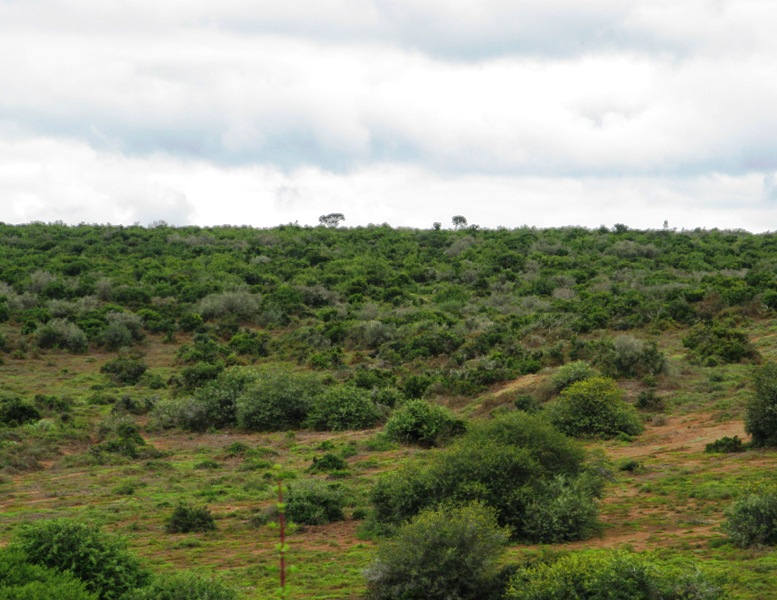
Our motor coach drove north toward the national game park for about an hour. We observed "the bush", sandy or clay soils covered in scrubby bush, small trees and succulent plants.  Our bus escort told us that most of the land was once cleared for farming.  Many of the farms have been abandoned and the wild plants are again taking over.  Farming in this part of South Africa is very difficult and younger sons and daughters are seeking other occupations.  There is also an issue of farm violence.  The guide was carefully not specific about who is committing this violence but there is obviously a severe problem.  We saw dairy and fruit farms dotted about the countryside.  There were also several very basic manufacturers of brick. The kilns were simply coal and mud packed around the dried clay bricks and set fire to burn for about a week. 

As we neared the elephant refuge, we saw signs for a local cement company.  The company has bought up a lot of acreage in order to mine limestone for cement production. They recently cut a deal with the national government to turn the land over to the game reserve when they have finished mining.  This will eventually almost double the reserve's present size.

Our"safari" consisted of a drive through the bush on pretty good roads in an open sided four wheel drive vehicle that held about twenty people.  Man-made waterholes were located conveniently close to the road.  The driver/guide was in radio contact with the other drivers so they could all spot the same game.  Even so, most of the game hid in the bushes away from sight.   Addo was originally created to preserve the Addo Elephant native to the area.  By the early 1930's the population had been hunted almost to extinction and only eleven elephants remained.  With conservation and expansion of the park, the population of elephants is now near 500.  In the past ten years the emphasis has shifted from preserving the Addo elephants to preserving their whole ecology.  Addo now houses black rhino, lion, and kudu. Eland, wildebeest, warthogs and other originally indigenous animals have also been reintroduced.

Michael and I were able to spot and photograph some jackals at the first waterhole.  At the next stop we saw some warthogs.  This was followed by a turtle crossing the road.  After a longish stretch of viewing grass, bushes and a few birds with beautiful blue mountains in the distance, we saw some meercats running across an open area.  Another long stretch of riding up hill and down and we finally saw a glimpse of a kudu.  Our guide told us that it had rained for the past three days and the animals were drinking from puddles instead of visiting the water holes. Maybe we would see elephants, maybe not.  Of course, we found a small herd of elephants.  The driver was in contact with all the others so, after an appropriate amount of suspense, there they were.  It is show business, after all.  Anyway, I had fun.  The animals were real and it wasn't Disneyworld.

Our elephant adventure took a bit longer than the schedule allowed.  We returned to the dock a few minutes late to find the gangway partially disassembled.  The ship's crew hurried us aboard and the ship departed almost immediately.  Our next stop on Tuesday is Maputo, Mozambique, a day and a half away.


--
Barbara Borsuk
barbara@mborsuk.com
Boulder, Colorado, USA
303 408-3639

Saturday, February 4, 2012

HALF A WORLD AWAY


Good day from just off the most southern coast of Africa.  I have taken a while to get this story started.  The past week or so has been more than hectic.  Today is our first full day on the Silver Wind and my first opportunity to sit still for a time and write.

Michael and I were getting ready to leave for this fantastic trip we have been planning since we got off this same ship in Monte Carlo last July.  Unexpectedly on Wednesday, four days before our departure, I received an offer on my house in Tennessee.  This was the first serious offer since July of 2010.  I negotiated with the purchasers through my Tennessee real estate broker by phone and e-mail.  I accepted a final offer on Thursday.  My Tennessee lawyer's office e-mailed the paperwork.  I signed everything necessary before a notary and mailed it off Friday.  Assuming everything goes smoothly, the closing will take place about the time we cross the equator on our way up the west coast of Africa.  A major expense will end in a positive way.  Truly something to celebrate.      

We made it to Cape Town by way of two overnight flights: from Denver to Frankfurt and after a ten-hour layover, from Frankfurt to Cape Town.  We were able to take a commuter train from the airport to Frankfurt and spend a few hours exploring that city in freezing cold but clear weather.

I took some pictures of quaint looking but restored buildings.  The city was bombed to smithereens during WW II and almost everything is either new or recreated.  Part of the city features new skyscrapers befitting the financial capital of Germany while the "old town" is somewhat reminiscent of Disneyland in its too perfect replication of ancient buildings. Michael and I took a bus tour of the city to escape the cold as much as anything.  Frankfurt is not a tourist city.  It took only an hour to see the sights. People were, for the most part friendly and helpful. I would have enjoyed it more if the temperature had been warmer.

One thing I have noticed lately is that everywhere - the U. S., Germany and South Africa are the most recent examples - wherever we are walking, people bump into us as if we are either invisible or inconsequential.  No one says, "Excuse me".  Is this a result of people living too much in virtual reality?  I don't think people are mean, just oblivious possibly not realizing they can't walk through solids or that other people are real.

Cape Town

We left Colorado Sunday afternoon and arrived in Cape Town late Tuesday morning with a nine-hour time difference.  I'm writing this in what would be the middle of the previous night in Boulder.  Considering the travel, we were not too jet-lagged to start exploring Cape Town.  Michael and I spent three days having a wonderful time.  We ate delicious meals, mostly seafood, in a variety of restaurants chosen at random.  We took a hop-on, hop-off city tour – this time getting off to see a number of sights up close.

We went to Robben Island to see where Nelson Mandela and the other political prisoners of Apartheid had been imprisoned. And we toured the Stellenbosch wine country tasting wine at two different wineries.  The only major tourist thing we did not do was take the cable car to the top of Table Mountain.  We will be back in ten days and maybe we will do that then.  

Yesterday, Friday, we were scheduled to board our cruise ship at 10:30 a.m.   The ship had been scheduled to dock at 7:00 a.m. less than a quarter mile from our hotel.  After breakfast, we walked to the pier.  No cruise ship was in sight.  Back in our hotel room, Michael checked the location of the Silver Wind on a ship-locator computer program he has on his notebook computer.  We saw the track of the Silver Wind going in circles in Table Bay.  We took a walk to the end of the breakwater to check it out. There we spotted the ship coming toward the harbor.  Instead of turning into the entrance, the Silver Wind turned the other way and began another circle.  The day was very windy and the harbormaster had closed the port.  We saw boats go in and out for about half an hour later in the morning.  The Silver Wind headed for the port entrance.  Unfortunately for our spirits, the port closed again and she had to resume her circles in the bay.

I have to compliment the Silver Seas cruise line for the way they handled the situation.  Their on-shore agents arranged a space in the Table Bay Hotel for us boarding passengers to wait and have a light lunch. Somehow, they gathered up the passengers from around the city. We were bused with our luggage to the hotel. Later, after the ship docked at the adjacent industrial port instead of at the cozy little Victoria and Alfred harbor, we were bused to the ship.  It was an interesting ride past shipping containers and cranes.  We passed a small yacht club right next to a set of dry docks.  The Silver Wind was in an empty (of ships) dry dock full of water.  Trucks and equipment almost blocked access to the gangway.  The ship staff got all of our luggage and us in board quickly.  They had a hectic day.  Not only did they handle a set of new passengers, they dealt with debarking passengers, some of whom had missed flights home due to the delays.

We learned that wind is continuous in the South African summer.  Winter, from May to September is the rainy season.  It is iffy for cruise lines to have ships visit Cape Town.  One of our tour guides mentioned that only about a dozen cruise ships visit the port in the summer.


--
Barbara Borsuk
barbara@mborsuk.com
Boulder, Colorado, USA
303 408-3639